Signs of the Times: Recession Ahead?
The indicators are pointing exactly to where you'd expect if a recession was coming.
This year, we seem to have been waiting for the "Godot Recession."
Will it ever show up?
Perhaps not. But it's tough to ignore the signs. The indicators are pointing exactly to where you'd expect if a recession was coming.
Indicator #1: Yield Curve In SMI's January 2023 Cover article, From Inflation to Recession, Mark focused on two indicators with strong track records of predicting future recessions. Ten months have come and gone without a formal recession being declared. So were those indicators wrong this time? Let's take a look at what they're saying today. The first indicator is the "inverted yield curve." An inversion occurs when short-term interest rates are higher than longer-term rates. That's unusual. Usually, short-term rates are the lowest because investors demand higher yields in exchange for tying up their money longer. Here's the yield curve situation now, compared to two years ago, shown via a helpful graphic from The Wall Street Journal.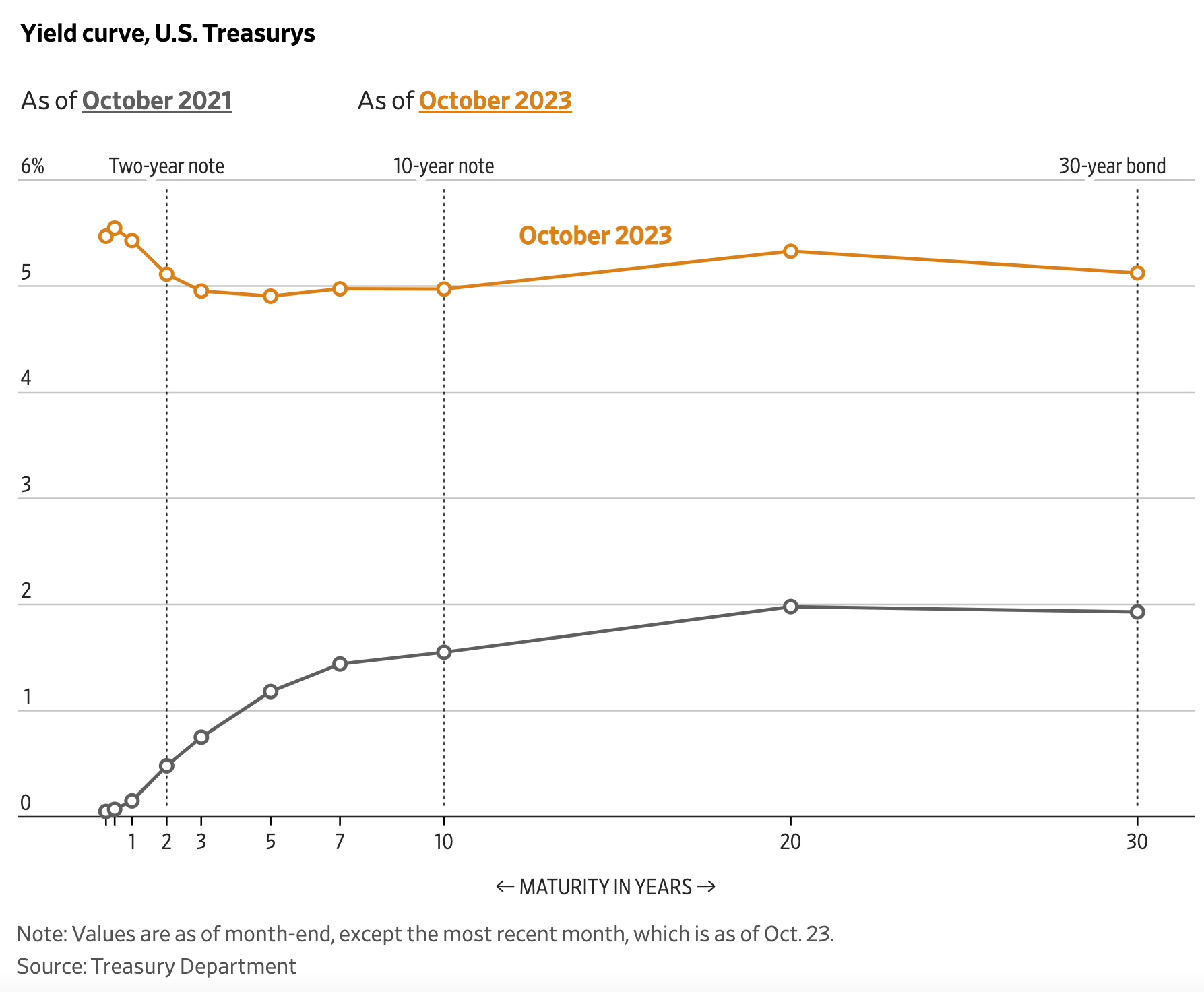
The graph below that illustrates the specific interest-rate relationship between the 10-year Treasury note and the 3-month Treasury bill over the past 40-plus years. The 10-year/3-month pair "has a perfect track record of predicting future recessions," as Mark noted in the January Cover article.
There's a two-step process to these yield curve inversions and the path to recession. First, the yield curve inverts — that's shown by the line crossing below the dark zero level. Second, you'll notice that just before each recession (shaded areas), there is a turning point (red circles), where the curve stops inverting further and begins to steepen back toward its normal shape (i.e., the line stops going down and turns higher).
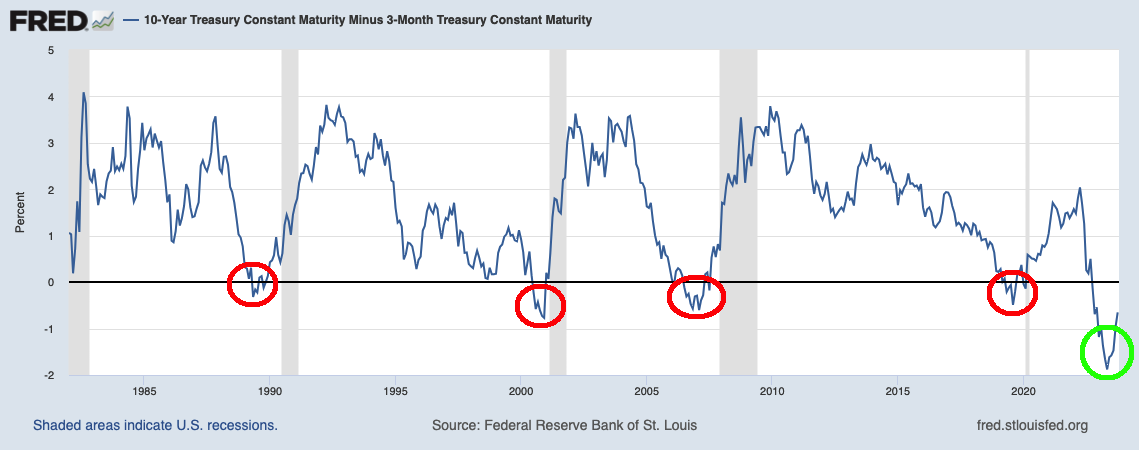
A similar turning point occurred a few months ago (green circle), suggesting that a recession probably isn't far away. Far from being a failed signal, the yield curve is doing exactly what we would expect it to if a recession was looming in the next few quarters.
Indicator #2: The Leading Index Another sign pointing (unambiguously) toward a recession is the Leading Economic Index, published monthly by The Conference Board. The index has posted declines for 18 months in a row, a losing streak exceeded only before/during the Great Financial Crisis 15 years ago.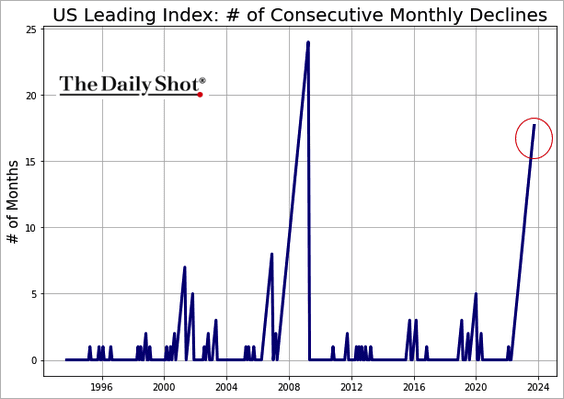 Delayed, but not diverted?
Despite the evidence piling up, the "Godot Recession" remains elusive. And indeed, most of us would be glad if it never arrived — or if it does come, we'd like it to be shallow and short!
Unfortunately, even if we're pretty sure a recession is on the way, we can never know its contours in advance. We're all in the same boat. No one knows what's ahead — not the Fed Chairman, not the Treasury Secretary, not Warren Buffett, and certainly not any financial TV pundit.
But we can heed the counsel of Proverbs 22:3: "The prudent see danger and take refuge, but the simple keep going and pay the penalty." (Or as the Contemporary English Version puts it, "When you see trouble coming, don't be stupid and walk right into it — be smart and hide.") On the personal-finance front, "taking refuge" or "being smart" involves such things as having adequate savings and minimal debt. On the investing side, it consists of taking measured steps to fine-tune market exposure based on your risk tolerance and season of life. Recessions come and go, as do market cycles. Whatever may unfold in the months ahead, following a reliable process, such as offered by SMI, can help you stay financially strong and steady. *Images used with permssion. *Related Articles

May 25, 2025
How To Choose The Right Financial Advisor
For Christians who want their finances to reflect their faith, it’s about more than just numbers and returns....

April 13, 2025
Time for Foreign Stocks to Shine?
Have stocks shifted in a different Direction? Recent pickup in foreign returns has certainly grabbed our attention....

March 18, 2025