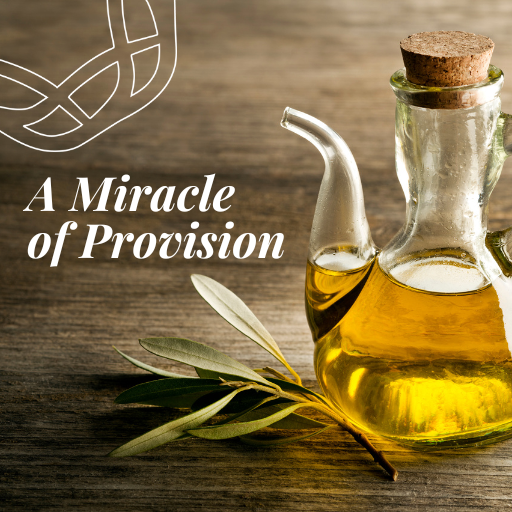
The story of the Widow’s Oil in 2 Kings 4 reveals a miracle of provision. Can we learn something from it ? Does God still provide for his people in miraculous ways? What can we glean from those seven verses in 2 Kings?
The story of the Widow’s Oil in 2 Kings 4 reveals a miracle of provision. Can we learn something from it and apply it to our lives? Does God still provide for his people in miraculous ways? An unexpected check in the mail just when the car needs new brakes? What can we glean from those seven verses in 2 Kings? This is MoneyWise Live - biblical wisdom for your financial decisions.
We should always have faith that God will provide, because He promises to, and He is always faithful. On the other hand, God is not an ATM machine, even though some people misinterpret the Widow’s Oil passage to mean something like that. It’s often used by proponents of the so-called “Prosperity Gospel,” or “Name it and claim it” followers, to imply that God will always answer your prayers with financial or material gain. Of course, that’s not at all what the Widow’s Oil story is about.
Here’s what the passage is really saying, starting with the first verse in 2 Kings 4, “Now the wife of one of the sons of the prophets cried to Elisha, ‘Your servant my husband is dead, and you know that your servant feared the Lord, but the creditor has come to take my two children to be his slaves.” What can we take from that? A couple of things, first, that the widow’s husband had been faithful and was deserving of God’s provision. But also, the creditor is acting against Jewish law by abusing a widow and orphans, and further, by threatening to enslave fellow Jews, which was also illegal.
That sets the stage for what follows in verse 2. There we read, “And Elisha said to her, ‘What shall I do for you? Tell me; what have you in the house?’ And she said, ‘Your servant has nothing in the house except a jar of oil.’” What can we make of that? It’s saying that we have a part to play in God’s provision. He expects us to use what we have, even if it’s only one jar of oil. God will often use what we already have to provide, in ways we can’t imagine.
Scripture also has something to say about “small beginnings.” Zechariah 4:10 reads, “Do not despise these small beginnings, for the Lord rejoices to see the work begin.”
Sometimes we don’t expect God to provide because we lack confidence in the resources He’s already given us. But when we fully grasp that God owns everything and that His resources are unlimited, our faith in His provision will grow, and so will our gratitude for what He's provided.
In 2 Kings 4 to verses 3 and 4, as Elisha speaks to the widow: “Then he said, ‘Go outside, borrow vessels from all your neighbors, empty vessels and not too few. Then go in and shut the door behind yourself and your sons and pour into all these vessels. And when one is full, set it aside.” There are several lessons here. First, the widow was obedient. She did exactly what Elisha, as God’s representative, told her to do. We must also be obedient as we expect God’s provision. That means following His financial principles found throughout the Bible. Second, the widow didn’t rely on her own resources. She went to her neighbors and asked for help by providing additional containers for the oil. It’s not always easy to ask others for help when we need it, and we can’t let our pride stand in the way.
And third, we learn that God will put people in your life who want to help you, if the need is real and you ask with humility. That won’t always be with money. It could be other resources, or maybe important information or advice that will help you turn things around. Again, don’t go it alone.
Continuing on with verses 5 and 6, “So she went from him and shut the door behind herself and her sons. And as she poured they brought the vessels to her. When the vessels were full, she said to her son, ‘Bring me another vessel.’ And he said to her, ‘There is not another.’ Then the oil stopped flowing.” Here we see the widow acting with humility. Can you imagine the temptation she must have felt to throw open the doors and tell the neighbors to see what she was doing? But the widow knew it was God’s hand at work, not hers, and she resisted any urge to claim credit for the miracle.
In verse 7 we read, “She came and told the man of God, and he said, ‘Go, sell the oil and pay your debts, and you and your sons can live on the rest.’” Here again we see that we have a part to play. The widow’s role wasn’t finished— she still had to sell the oil in the marketplace and pay off the creditor. But we also see that God provides exactly what was needed. Not only did the widow have enough to satisfy the creditor, but there was enough left over to live on until her sons could start providing for her, which was the custom of the day. Otherwise, she still would have been destitute and may have gone into debt again.
The overall lesson in 2 Kings 4 is that in our weakness, we see God’s strength. We’re reminded of our dependence on God.
On-Air Mention:
As we’re talking about today’s topic of God’s provision, we have a fantastic collection of inspirational stories and videos on moneywise.org that all share about the faithfulness of God in people’s lives. What a great way to focus on an attitude of gratitude during this season. We also have articles, podcasts, and videos from over 16 content partners, making it a convenient source for the latest and best content on biblical finances. It’s free and available to you anytime–go to moneywise.org and use the search button to find wisdom on any financial topic.
Next, Rob answers these questions at 800-525-7000 or via email at Questions@MoneyWiseLive.org:
If you work at a VA, have TSP, you contribute the matching percentage of 5% and you have about $60,000 balance right now, should you increase the contributions, or open an Roth IRA and contribute the overage of the 5% to that?
If you have an auto warranty that's about to expire, should you pursue finding a replacement?
If you're 63, you have $390,000 in your 401(K), your monthly expenses are around $1,000 per month, age 66 1/2 is your Social Security retirement age and you're currently working part-time, how can you determine whether you should stay part time, take retirement or go back to full-time employment?
If you're 61 and looking for to retirement, you're widowed and work in healthcare (which you find physically taxing,) you're struggling to find anything that would pay more in your field, what are the Social Security pros and cons of retiring at age 65 versus 67?
If you are aged 61, retired but substitute at the local school, your husband is 64 and semi-retired drawing Social Security and works part time have 2 rental properties that have done well, right now, you have about $38,000 in some IRAs plus two properties you're thinking of selling worth about $40,000, should combine those two sources and buy another rental property?
If you work a job that has a 401(k) and stock purchase plan that you participate in, what should you do with those accounts when you leave the job?
Be sure to check out the rest of MoneyWise.org to connect with a MoneyWise Coach or access our books and our many free helpful resources. You can also find us on Facebook (MoneyWise Media) and join the conversation. Thanks for your prayerful and financial support that helps keep MoneyWise on the air. And if you'd like to help, just click the Donate tab at the top of the page.